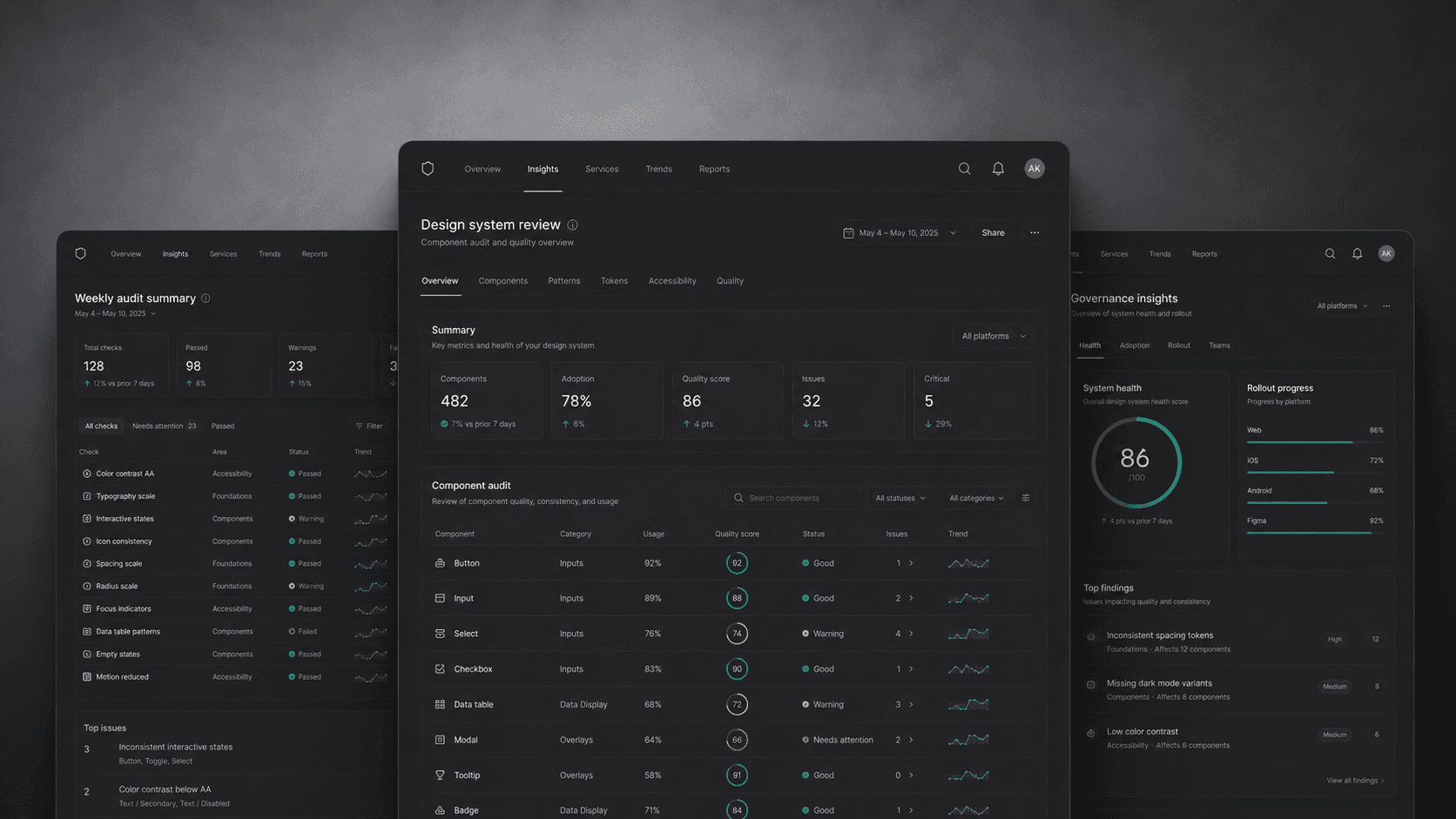
Product Review Dashboard
Redesigned a product-review workflow so teams could compare research, metrics, ownership, and launch risk before committing roadmap scope.
The product team had enough reporting, but not enough decision clarity. Metrics lived in dashboards, research lived in notes, launch risks lived in meetings, and ownership often became visible only after work had already moved too far downstream.
The redesign turned the review surface into a shared decision system. Instead of treating analytics as a passive status layer, the dashboard was rebuilt around what teams needed to compare before committing scope: signal quality, user evidence, dependencies, confidence, and next action.

The key decision was to stop optimizing the dashboard for completeness and start optimizing it for review. That meant prioritizing fewer objects, clearer states, and stronger relationships between research inputs, metric movement, and roadmap implications.
The workflow was reorganized around repeatable review moments: what changed, why it matters, who owns the follow-up, and whether the evidence is strong enough to justify action. This made the interface less like a reporting archive and more like an operating rhythm for product judgment.

Supporting proof included dashboard audits, decision-mapping workshops, stakeholder interviews, review-state diagrams, and annotated examples of where teams were misreading or over-weighting isolated metrics. These artifacts exposed the gap between data visibility and decision readiness.
The strongest evidence came from repeated review scenarios. When teams could see metric movement next to ownership, confidence, customer evidence, and launch risk, the conversation shifted from “what does the chart say?” to “what decision are we ready to make?”

The new review model gave product, design, and leadership a clearer way to inspect progress without turning every meeting into a context-recovery exercise. It reduced ambiguity around ownership and made weak evidence easier to spot before it hardened into roadmap commitment.
The larger lesson was that dashboards do not create alignment by exposing more data. They create alignment when they make the cost, confidence, and consequence of a decision easier to see together.